
In a deep plane facelift, the face is lifted beneath the SMAS, the firm layer of muscle and fibrous tissue that lies under the skin and fat. Releasing the ligaments that hold the cheek and jowl down allows the skin, fat and SMAS to be lifted together as one composite unit.
Because the lift is made in the deeper layer, the skin is not pulled. The result is a smoother, more natural contour of the cheek, jawline and neck.
When the neck has also changed, a deep contouring neck lift is usually performed at the same time.
A deep plane facelift is usually performed under general anaesthesia, and most patients stay in hospital for one night.
Where general anaesthesia is a particular health concern, other arrangements can be discussed.
The incision starts in or along the hairline at the temple and follows the natural curves in front of the ear, running just inside the edge of the ear where possible.
In a full facelift it continues around the ear lobe and behind the ear, then into or along the hairline at the back, where it is well hidden.
When the neck is treated, a short incision is made in the natural crease under the chin.
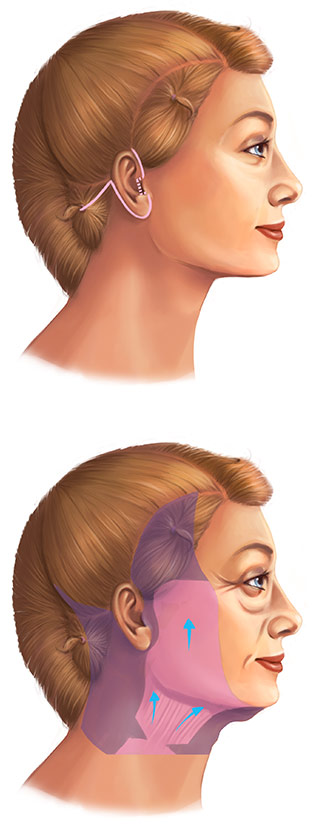
When the neck still has a good contour, the deep plane facelift can be performed through a short scar. The incision runs in front of the ear and stops around the ear lobe, with little or no extension behind the ear.
The deep plane lift and the release of the ligaments are the same as in a full facelift, so the cheek, jowls and jawline are lifted in the same way. This option suits earlier changes in the lower face, and recovery is usually a little quicker.
The SMAS (Superficial Musculo-Aponeurotic System) is a layer of muscle and fibrous tissue that runs continuously with the platysma muscle of the neck. It is stronger and more stable than the skin.
Retaining ligaments anchor the soft tissues of the face to the bone and deeper structures. The main ones are the zygomatic ligaments over the cheekbone, the masseteric ligaments along the side of the face, and the mandibular ligament at the front of the jawline. As the soft tissues descend with age, these ligaments hold them back unevenly, which contributes to the jowls and the fold between the nose and mouth.
In a deep plane facelift these ligaments are released. The skin, fat and SMAS of the cheek can then be repositioned together, as one composite unit, without separating the skin from the layers beneath it. This lifts the cheek and jowl more effectively than tightening the SMAS from above, softens the fold between the nose and mouth, and gives a smoother overall result, without a pulled look.
Excess fat in the lower cheeks and under the chin can be reduced to refine the jawline. Where volume has been lost, fat transfer can soften areas that have become hollow with age.
Once the tissues have been repositioned, the skin is redraped over them without tension, and only the excess skin is removed. Because the lift is carried by the deeper layer, the scars are not under strain, which helps them heal finely.
The incisions are closed with fine sutures in front of the ear. In the hair, care is taken to protect the hair follicles.
Ultrasonic instruments are used for a large part of the operation, which helps to control bleeding precisely. A light dressing is used for the first night only, and no drains are used. Where needed, quilting sutures hold the skin against the tissues beneath it, so that fluid cannot collect; if used, they are removed three days after surgery.
 Questions? Just ask.
Talk to our helpful team or book a consultation
with Mr Lucian Ion. Call 0207 486 7757
About our practice
Facial surgery
Breast surgery
Body contouring
More information